

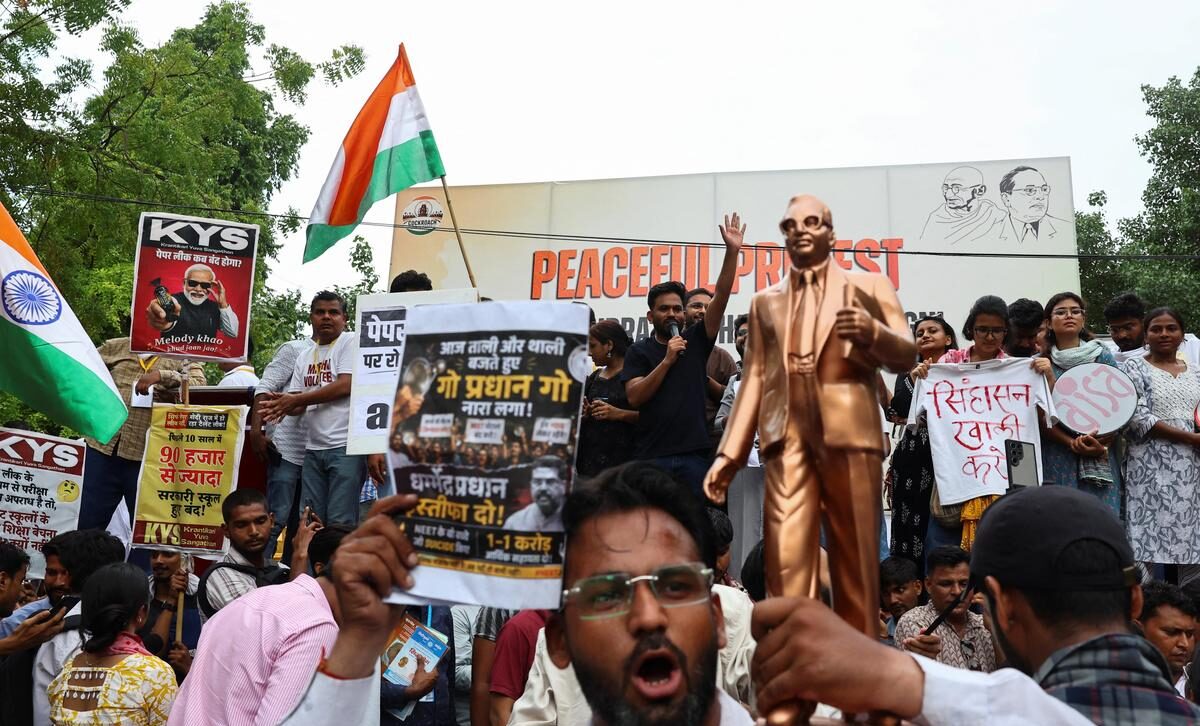
A student-led protest in New Delhi demanding the resignation of Education Minister Dharmendra Pradhan entered its third day on Sunday, with hundreds of students, job seekers and young professionals gathering at Jantar Mantar to voice concerns over the handling of the NEET-UG examination controversy.
The demonstration is being spearheaded by the Cockroach Janata Party (CJP), a newly formed collective that has gained prominence through its satirical approach to politics and advocacy for greater accountability in India’s education system. The group’s mascot, a cockroach, emerged from an online movement that challenged remarks made by India’s chief justice regarding unemployed youth.
The protests were triggered by allegations of a paper leak in the NEET-UG medical entrance examination, one of the country’s most competitive tests. Following widespread criticism from students and parents, authorities cancelled the original results and ordered a re-examination. Millions of candidates appeared for the fresh test on Sunday under enhanced security measures, including biometric verification.
Despite the successful conduct of the re-test, according to the National Testing Agency (NTA), protesters argue that the issue extends beyond a single examination. Demonstrators say the controversy reflects broader concerns about transparency, accountability and trust in the education system.
CJP founder Abhijeet Dipke, a student at Boston University, urged supporters to continue pressing for reforms and accountability. The group has organized protests in multiple cities and attracted significant attention on social media, where its campaigns have gained widespread support.
The sit-in at Jantar Mantar began on June 19 after receiving police permission for a limited protest. When the permit expired, demonstrators chose to remain at the site, vowing to continue until their demands are addressed. Many protesters spent nights outdoors, supported by volunteers providing food and water.
Participants from various backgrounds, including students, professionals and ordinary citizens, have joined the movement, arguing that a credible and accountable education system is essential for the country’s future. As the protest continues, organizers insist their campaign is focused on systemic reforms rather than a single examination dispute.
