

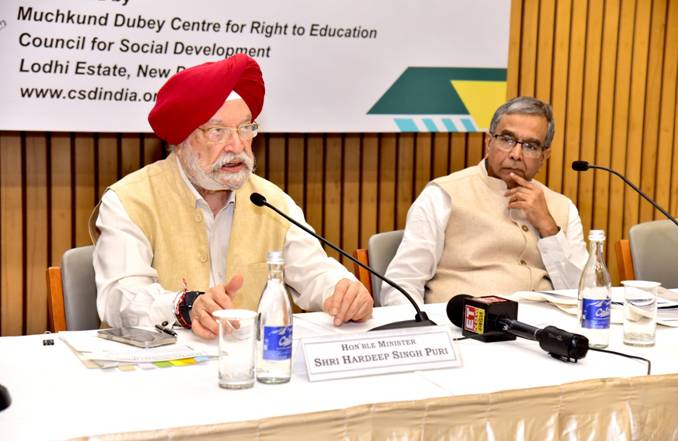
As India aspires to become a $35 trillion economy by 2047, the foundation of this growth must be built on education, said Shri Hardeep Singh Puri, Union Minister of Petroleum and Natural Gas. Speaking at a seminar titled “School Education in India: Towards Equitable Access to Quality Education for All”, organised by the Council for Social Development, the Minister emphasised that inclusive, high-quality education is the cornerstone of nation-building and societal progress.
Shri Puri highlighted that education is not just a policy issue but a national imperative. “As our country develops, education must remain the central focus,” he stated, stressing the role of schools in nurturing a generation of responsible, productive citizens who can propel India’s journey from its current $4 trillion economy to the ambitious $35 trillion mark by the centenary of independence.
Reflecting on key policy milestones, Shri Puri acknowledged the transformational impact of the 86th Constitutional Amendment Act passed in 2002 during the Vajpayee government, which elevated free and compulsory education for children aged 6–14 to a Fundamental Right under Article 21A. This laid the foundation for the Right to Education (RTE) Act enacted in 2009. Since then, the momentum has continued, especially under the leadership of Prime Minister Shri Narendra Modi, who has prioritised education through flagship schemes and strong implementation frameworks.
Drawing on data from UDISE and ASER reports, the Minister noted several encouraging outcomes since the enactment of the RTE Act and its intensified implementation over the past decade. India’s youth literacy rate now stands close to 97 per cent. The gender gap in literacy has significantly narrowed, driven by schemes like Beti Bachao Beti Padhao and Swachh Bharat Abhiyan. School enrolment has also improved dramatically—with primary enrolment rising from 84% to 96%, and upper primary from 62% to 90%.
He further outlined progress in school infrastructure and human resources:
-
The teacher-pupil ratio has improved from 42:1 to 24:1.
-
Schools with separate girls’ toilets have increased from 30% to 91%.
-
Schools with electricity have risen from 20% to 86%.
-
The dropout rate has sharply declined from 9.1% to just 1.5%.
Shri Puri also reflected on India’s educational progress since independence, when the literacy rate stood at merely 17%. Today, it is around 80%, according to NSSO data—a testament to the country’s commitment to education and a signal that the goal of universal literacy is now within reach.
While acknowledging that he is not an education policy expert, Shri Puri reiterated his belief that national development cannot be achieved without placing education at the forefront. He called for education to be treated as a bipartisan priority, rising above political differences.
The event also marked the inauguration of the Muchkund Dubey Centre for Right to Education, established in memory of the renowned diplomat, scholar, and public intellectual, Prof. Muchkund Dubey. Shri Puri paid tribute to Prof. Dubey’s legacy, describing him as a mentor and visionary who dedicated his life to ensuring equitable and quality education for every child in India.
