

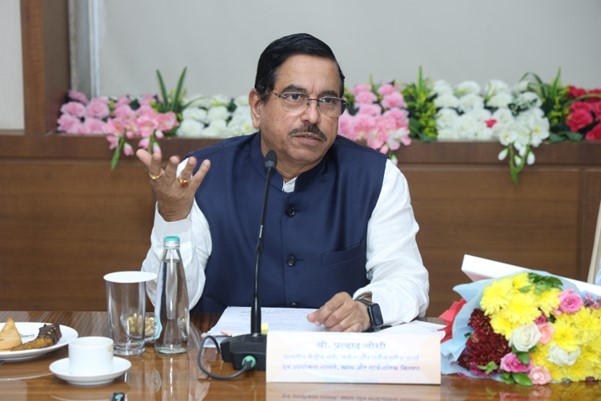
Union Minister for New and Renewable Energy and Consumer Affairs, Food and Public Distribution, Shri Pralhad Joshi, recently visited the National Centre for Photovoltaic Research and Education (NCPRE) at IIT Bombay. During his visit, he held an interactive session with NCPRE’s Investigators and Advisory Board Members and toured advanced research laboratories, including the Perovskite Tandem Solar Cell Lab, the Silicon Fab Laboratory, and the Medium Voltage Laboratory.
A highlight of the visit was the presentation of a significant technological breakthrough by an IIT Bombay-incubated startup, Advanced Renewable Tandem-Photovoltaics India (ART-PV India). The startup has developed a 4-terminal Silicon/CdTe-Perovskite tandem solar cell that boasts a conversion efficiency of 29.8%, setting a national benchmark and placing India among global leaders in solar energy technology.
NCPRE was established in 2010 at IIT Bombay with financial support from the Ministry of New and Renewable Energy (MNRE), Government of India. Since its inception, MNRE has provided over ₹200 crore to support NCPRE’s R&D and educational initiatives, aligned with India’s ambitious 100 GW solar mission.
To further strengthen domestic innovation, MNRE is also supporting ART-PV India with $10 million (approx. ₹83 crore) to set up a state-of-the-art pilot manufacturing facility within the IIT Bombay campus. This facility will help transition lab-scale innovations into scalable industrial products and promote indigenous Intellectual Property in clean energy technology.
Speaking to the media after his visit, Shri Joshi commended the team’s pioneering work in high-efficiency, low-cost Silicon-Perovskite Tandem Solar Cells, describing it as a “game-changer” for India’s solar future. He emphasized that the innovation aligns with global demands for efficient, affordable, and scalable solar energy solutions and gives India a leadership edge in next-generation photovoltaics.
“This is not just a laboratory innovation,” the Minister stated, “but a blueprint for clean, scalable, and Aatmanirbhar energy production. The technology has the potential to surpass 30% efficiency, far beyond the capability of conventional panels.” He reiterated MNRE’s commitment to supporting groundbreaking R&D in perovskite solar cells, inverter technology, PV reliability, green hydrogen, and energy storage.
Shri Joshi also highlighted MNRE’s role in building India’s self-reliance in the renewable energy sector under the Aatmanirbhar Bharat vision. Through programs like the Renewable Energy Research & Technology Development (RE-RTD) scheme and increased R&D funding, MNRE is strengthening India’s innovation-to-commercialization ecosystem.
He encouraged the ART-PV and NCPRE teams to commercially demonstrate the scalability and profitability of the Perovskite Tandem Solar Cells, stating that real-world adoption by industry would bolster India’s innovation ecosystem and manufacturing capabilities.
The Minister also pointed to the recent approval of the Research Development and Innovation (RDI) Scheme by the Union Cabinet, along with a significant allocation of ₹1.27 lakh crore for Gross Expenditure on Research and Development (GERD), as proof of the government’s strong focus on research-driven growth.
Present during the visit were IIT Bombay Director Prof. Shireesh Kedare, NCPRE Principal Investigator Prof. Baylon G. Fernandes, and ART-PV India Co-Founder Prof. Dinesh Kabra. The event served as a testament to the powerful collaboration between government, academia, and industry in driving India’s clean energy future.
