

(HT)
Prime Minister Narendra Modi on Friday inaugurated one of the most ambitious railway projects in India, which will connect the Kashmir Valley to the vast Indian plains by train for the first time.
Dubbed by government-operated Indian Railways as one of the most challenging tracks in the world, the 272-kilometer (169-mile) line begins in the garrison city of Udhampur in Jammu region and runs Kashmir’s main city of Srinagar. The line ends in Baramulla, a town near the Line of Control.
The line travels through 36 tunnels and over 943 bridges. The government pegged the total project cost at around $5 billion.
One of the project’s highlights is a 1,315-metre-long (4,314-foot) steel and concrete bridge above the Chenab River connecting two mountains with an arch 359 meters (1,177 feet) above the water. Indian Railways compared the height to the Eiffel Tower in Paris, which stands 330 metres (1,082 feet), and said the bridge is built to last 120 years and endure extreme weather, including wind speeds up to 260 kph.
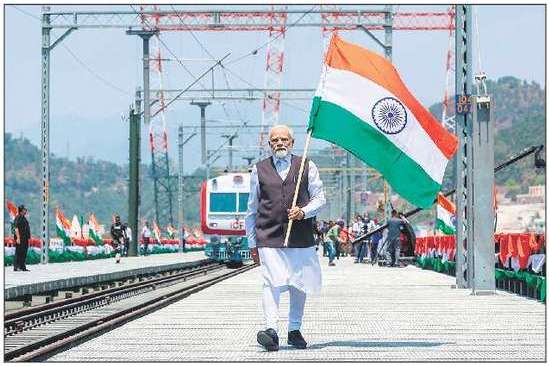
The Prime Minister visited the Chenab bridge with tight security, waving an Indian tri-colour flag before boarding a test train that passed through picturesque mountains and tunnels to reach an inauguration ceremony for another high-elevation bridge named Anji.
The prime minister also helped launch a pair of “Vande Bharat” trains that will halve the travel time between Srinagar and the town of Katra in Jammu to about three hours from the usual six to seven hours by road.
It was the Prime Minister’s first visit to Kashmir since a military conflict between India and Pakistan brought the nuclear-armed rivals to the brink of their third war over the region last month, when the countries fired missiles and drones at each other.
The conflict began with a gun massacre in late April that left 26 people, mostly tourists, dead in Pahalgam. India blamed Pakistan for supporting the attackers, a charge Islamabad denied.
Addressing a public rally in Reasi, Modi lashed out at Pakistan and alleged Islamabad was behind the massacre. He said the attack was primarily aimed at Kashmir’s flourishing tourism industry and meant to fuel communal violence.
“Unfortunately, our neighbouring country is against humanity and even the livelihood of the poor. What happened in Pahalgam on 22 April is an example of this. Pakistan attacked both ‘insaniyat and Kashmiriyat’ in Pahalgam. Its purpose was to cause riots in India and to obstruct the earnings of the hard-working people of Kashmir. That is why Pakistan attacked the tourists in Kashmir… Pakistan targeted the tourism that earns the families of Kashmir a livelihood…”
“I promise you, I won’t let developmental activities stop in Kashmir,” Modi said, adding that local industries and businesses will get a boost from the new rail connectivity,” he said.
The Prime Minister also praised the courage of Adil, who stood up to the terrorists in Pahalgam and lost his life. He said the bravery shown by the people of Jammu and Kashmir has sent a strong message to the terrorists around the world.
“Adil, who challenged the terrorists, had also gone to Pahalgam to work so that he could take care of his family. But the terrorists killed him too… The strength that the people of Jammu and Kashmir have shown during this time has sent a stern message to the terrorist mentality of the world,” Modi said.
The railway project is considered crucial to boosting tourism and bringing development to a region that has been marred by militancy and protests over the years. The line is expected to ease the movement of Indian troops and the public to the region, which is currently connected by flights and mountain roads that are prone to landslides.
Referring to Operation Sindoor, Modi said that whenever Pakistan hears that name, it will be reminded of its humiliating defeat.
“The Pakistani army and terrorists never thought that India would enter hundreds of kilometers inside Pakistan and attack terrorists. The buildings of terror were converted into heaps of rubble in few minutes,” he said.
Modi added that stung by India’s Operation Sindoor, a desperate Pakistan attacked innocent people including children in Jammu and Poonch.
“Over 2000 families were also affected by enemy shelling. They were given financial aid to repair their houses. Now, the Centre has decided to increase it. I want to inform you that the houses which suffered extensive damage will get Rs 2 lakh and those partially damaged will get Rs 1 lakh assistance over and above the financial aid which has already been given.”
Chief minister Omar Abdullah and Union rail minister Ashwini Vaishnaw were also present at the event.
“Even the British wanted to connect Kashmir by train but they did not succeed… What the British could not achieve has happened at your (Modi’s) hands and Kashmir has been connected to the rest of the country,” Abdullah said
Hailing the completion of the project, Vaishnaw said: “The nation nurtured the dream of this raily line but there were many difficulties… [The project] became possible due to the strong will and determined endeavour of the Prime Minister.”
Jammu and Kashmir Lt Governor Manoj Sinha on Friday said ‘Kashmir to Kanyakumari’ is no more a slogan but has become a reality with the flagging off the Vande Bharat train to the valley.
The inauguration of the Kashmir rail service has connected hearts of people of J-K with rest of the country and will pave way for economic prosperity for the region, he said.
“I feel Kashmir to Kanyakumari is not just a slogan any more after the prime minister showed the green flag to the Katra-Srinagar and Srinagar-Katra Vande Bharat trains sometime back. It is now a reality,” Sinha said at the public rally.
He said by connecting the two extreme regions of the country by rail, the dream of former home minister Sardar Vallabhbhai Patel and Syama Prasad Mookerjee was also fulfilled. “You have not only connected the railway network but also connected the hearts of lakhs of Indian citizens today,” Sinha said.
