

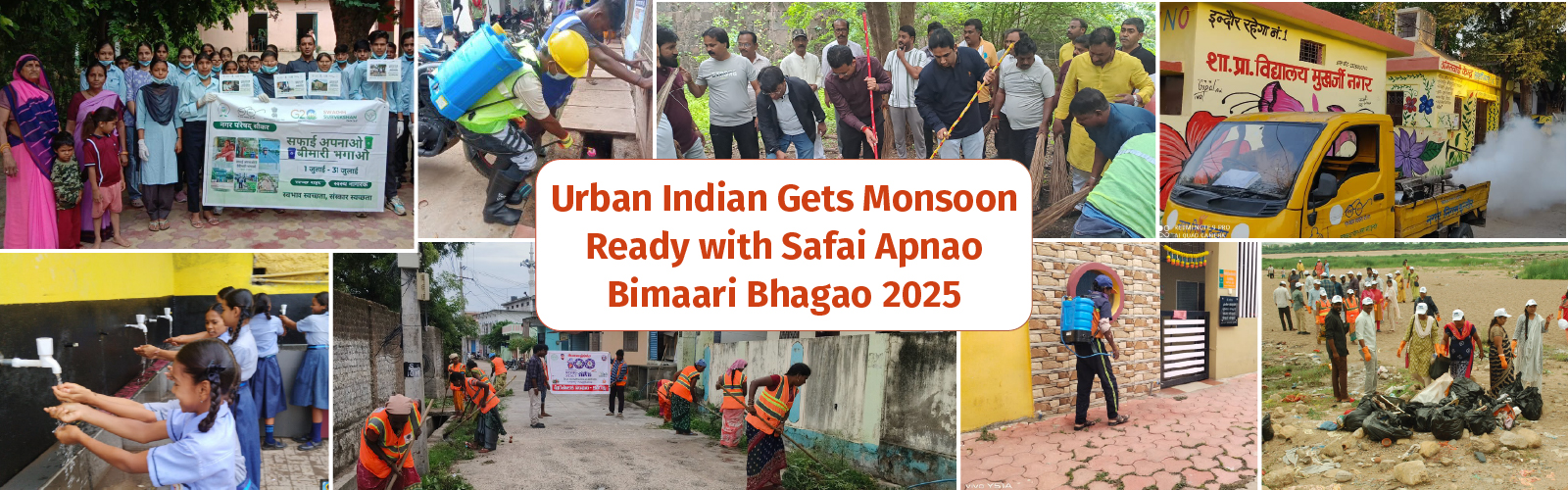
With the arrival of the monsoon, urban India is rallying under the Ministry of Housing and Urban Affairs’ (MoHUA) flagship campaign ‘Safai Apnao, Bimaari Bhagao 2025’ (July 1–31). This nationwide initiative aims to tackle the health and sanitation challenges posed by the rainy season through a blend of public awareness, community action, and innovative municipal interventions.
Across the country, urban local bodies (ULBs) are intensifying efforts to prevent disease outbreaks by unclogging drains, eliminating garbage hotspots, and promoting hygiene—especially in vulnerable areas like slums, schools, and markets. The campaign reinforces the ‘6 Swachhata Mantras’: clean hands, homes, neighbourhoods, toilets, drains, and public spaces—turning monsoon preparedness into a community-driven movement.
In Patna, the Municipal Corporation has launched ‘Manhole Ambulances’—repurposed municipal vehicles outfitted with tools, prefabricated covers, and emergency repair teams. These units are now operational across six city zones and are integrated with PMC’s central control room for real-time complaint resolution. This builds upon successful models like Pink Toilets and Loo Cafés, further enhancing urban safety during heavy rains.
Meanwhile, the Municipal Corporation of Delhi (MCD) has launched a series of impactful drives under the campaign. In the South Zone, over 400 NCC girl cadets led a 3-km ‘Pinkathon’ walkathon, raising awareness on monsoon hygiene. City-wide efforts included handwashing drives in 255 schools, 206 clean-up activities in back lanes and Garbage Vulnerable Points (GVPs), and 469 sanitation operations in public toilets. The New Delhi Municipal Council (NDMC) focused on drain cleaning and urged citizens not to dispose waste into open drains, alongside comprehensive vector-borne disease surveillance and fogging within the Parliament area.
In Navi Mumbai, a large Swachhata rally was held in collaboration with Dnyandeep Seva Mandal High School, Karave, drawing participation from over 600 students, teachers, parents, and citizens. The Navi Mumbai Municipal Corporation also conducted health camps across 26 Urban Primary Health Centres, with 52 camps reaching 22,690 residents, focusing on dengue and malaria prevention. Intensive sanitation drives by workers further strengthened city hygiene.
In Telangana, the campaign saw massive participation, with 13 lakh households covered in a door-to-door waste segregation drive. ULBs across the state carried out 14,210 km of drain desilting, cleared 4,343 km of roadside vegetation, sanitized 2.5 lakh homes, and cleaned 500+ overhead water tanks. Health camps benefited 8,500+ frontline workers, and 140 composting pits were created in schools to promote composting.
Chhattisgarh also made notable strides. In Pandariya, Self-Help Groups were trained in sanitation practices and introduced to the Swachhata App, followed by a cleanliness drive at the SLRM Centre. In Raipur, extensive awareness campaigns promoted hand hygiene, clean neighbourhoods, and waste segregation, coupled with GVP beautification.
Through collective action, innovation, and community engagement, the ‘Safai Apnao, Bimaari Bhagao 2025’ campaign is uniting India’s cities to build healthier, cleaner, and more resilient urban spaces during the monsoon season.
