

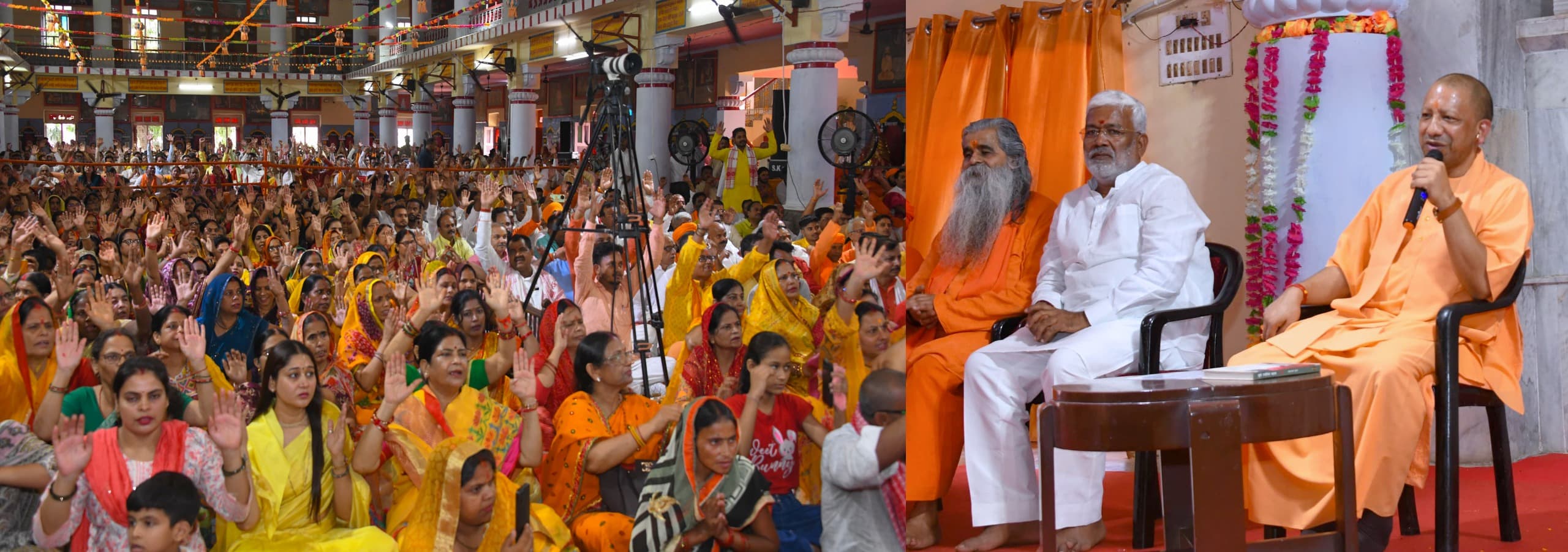
At the concluding ceremony of the Shri Ram Katha and Guru Purnima Mahotsav at Digvijaynath Smriti Bhavan in Gorakhnath Temple, Uttar Pradesh Chief Minister Yogi Adityanath delivered a heartfelt address centered on India’s cultural roots, spirituality, and civilizational strength.
Speaking before a large gathering of saints, devotees, and dignitaries, the CM firmly stated that India cannot move forward without Lord Ram, Lord Krishna, and Lord Shiva. He invoked the ideology of socialist icon Dr. Ram Manohar Lohia, highlighting how Lohia once said that as long as Indians continue to worship Shri Ram, Murli Manohar Krishna, and Mahadev Shankar, no force in the world can harm the country.
Yogi expressed regret that today’s so-called followers of Lohia have strayed from his path. “Those who oppose Shri Ram are destined for downfall,” he said, calling it a truth rooted in both spiritual and historical experiences.
He stressed that Sanatan Dharma is not merely a religion but a way of life, deeply woven into the cultural and spiritual identity of India. Lord Ram, Krishna, and Shiva, he said, are not just religious figures but timeless ideals representing values that uphold the nation.
Illustrating this, he narrated the story of Maricha from the Ramayana, who, despite his noble birth, perished tragically for betraying dharma. “It’s not about who you are by birth, but what you do in life,” the CM said, adding that even an illiterate person like Hanuman gained divinity through unwavering devotion and service to Lord Ram.
The CM quoted a Muslim woman lawyer, who once told him, “My mode of worship is Islam, but my religion is Sanatan.” Through this, he highlighted that Sanatan Dharma is inclusive, not restricted by ritual or identity, but expansive enough to embrace all who live by its values.
Calling the Ramayana timeless, Yogi Adityanath shared how, even in the digital era, it continues to touch lives. “During the COVID-19 lockdown, it was the most watched show on Doordarshan,” he said. “Back when half of India lacked TVs, 66 crore people still watched it.” He described it as a story that continues to unite and inspire generations.
He described Guru Purnima as a moment to express gratitude to our teachers and guides, a virtue India has always cherished. Referring to Hanuman’s gratitude toward Mount Mainaka, he explained how Sanatan Dharma values thankfulness, even for small acts of kindness. He reminded the audience that Guru Purnima also celebrates the birth of Maharishi Ved Vyas, who preserved Indian wisdom for future generations.
Hitting back at modern critics who mock religious devotion, CM Yogi cited the Mahakumbh in Prayagraj, where influencers tried to ridicule barefoot devotees. But the devotees responded calmly: “We’re the ones walking; why are you the one bothered?” He emphasized that negativity doesn’t help build a nation, but faith and balance between tradition and development do.
Highlighting development efforts, the CM proudly noted that over 37 crore saplings were planted in a single day across Uttar Pradesh, and 241 crore trees in the past nine years. He underlined that true progress must be sustainable, and environmental restoration is key to a better future. He also stressed the importance of reviving river culture, calling rivers the arteries of Mother Earth. “As our bond with rivers weakens, pollution and diseases rise,” he said.
CM Yogi also addressed the massive public health victory over encephalitis, a disease that haunted eastern UP for decades. “More than 50,000 children died over 40 years in Gorakhpur and nearby districts,” he said. “But with clean water, sanitation, and government focus, the disease was wiped out in just three years after 2017.”
The event concluded with a grand aarti of the Shri Ramcharitmanas Granth, led by the CM himself. He extended his gratitude to Acharya Shantanu Ji Maharaj, the Katha Vyas, and praised folk singer Rakesh Srivastava, who mesmerized the audience with his bhajan. Also present were Ministers Swatantra Dev Singh and Sanjay Nishad, MP Ravi Kishan, and several saints and scholars. The message was loud and clear: Sanatan Dharma is not just India’s past—it’s its path to the future.
