

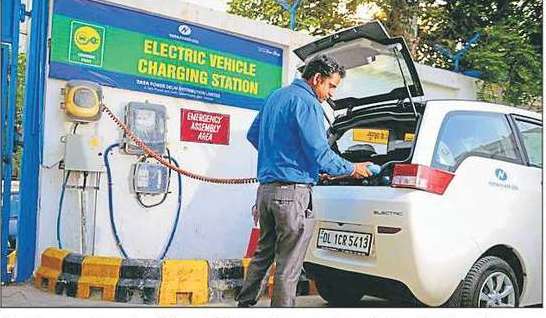
(HT)
The Prime Minister’s Office (PMO) believes the Centre needs to support all clean-fuel vehicles, including hybrids, even as a rift widens in the Indian auto industry over hybrids being put on par with pure electric vehicles (EVs).
The stand, confirmed by two top government officials, comes after makers of electric and hybrid vehicles sought the Centre’s favour after several states proposed incentivising electric, hybrid and CNG vehicles equally.
“I do not understand why there is so much lobbying. State policies may differ, but the central government has supported both EVs and hybrids in clean mobility schemes. It cannot be that you incentivise one and not the other. The idea is to help all forms and all clean fuels,” one of the two officials said on the condition of anonymity.
The incentives for EVs and hybrids are aimed at reducing the country’s fuel imports and carbon emissions. “All clean mobility initiatives which contribute to this have been incentivized so far, and will continue to be so,” the second official said, also on the condition of anonymity.
Mint reported on June 6, quoting Union heavy industries minister H.D. Kumaraswamy, that the government would continue to support all forms of clean mobility, including hybrid vehicles. In the past too, the Centre supported hybrids and EVs alike in various subsidy schemes, including the second iteration of the Faster Adoption and Manufacturing of (Hybrid &) Electric Vehicles in India (FAME India), which ran from 2018-19 to 2023-24.
Eventually, support for clean-fuel cars was removed under the PM E-Drive scheme (2023-24 to 2025-26). However, it continues to incentivise pure electric buses and electric and hybrid ambulances. Still, the Union government will continue to support policies to promote clean mobility through all possible means, including EVs, hybrid vehicles, as well as vehicles running on CNG and LNG, the officials cited above said.
India’s major EV makers include Tata Motors Ltd, Mahindra & Mahindra Ltd, Hyundai Motor India Ltd, Kia India Pvt. Ltd, and JSW MG Motor India Ltd. The hybrid carmakers are led by Maruti Suzuki India Pvt. Ltd, Honda Cars India Ltd, and Toyota Kirloskar Motor Pvt. Ltd.
“Tata Motors believes that government incentives should be directed towards promoting zero-emission technologies such as EVs by bridging funding gaps, developing enabling infrastructure, and accelerating innovation to help them reach scale and maturity. Hybrid is an incremental and mature ICE technology, which is commercially viable and faces no funding or adoption barriers that typically warrant government support,” a spokesperson said in an emailed statement.
The spokesperson added that hybrids use fossil fuels, resulting in PM2.5, CO2, and other tailpipe emissions like any other ICE vehicles.
Rahul Bharti, senior executive officer, corporate affairs, Maruti Suzuki, countered that strong hybrid EVs reduce CO2 emissions by 25% to 31% over pure petrol vehicles and increase energy efficiency by 36% to 44%, but they still have a viability gap.
“So, the tax cannot be the same for a strong hybrid and a pure petrol/diesel vehicle. Data shows that wherever SHEVs have been incentivized, the sales of BEVs have not fallen at all; on the contrary, they have gone up. SHEVs will help reduce pure diesel/petrol cars, and that is in the national interest,” he added.
