

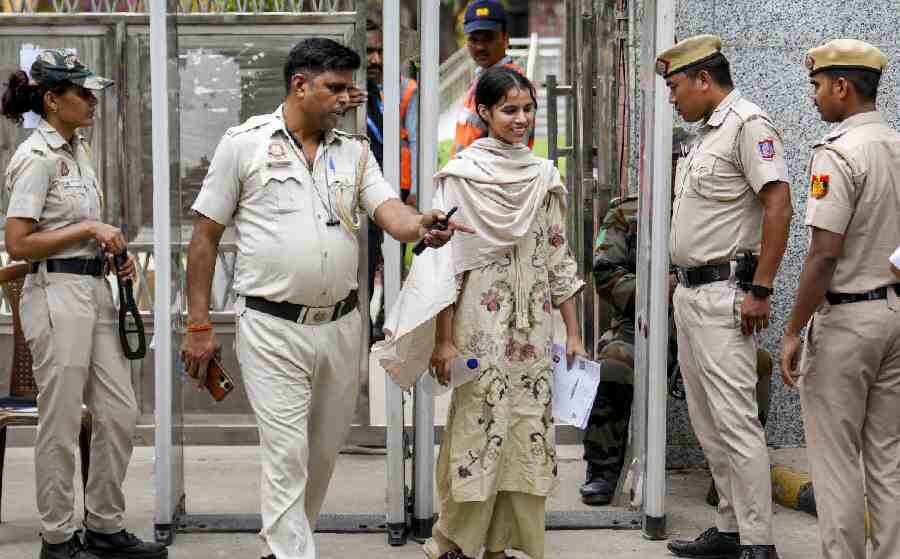
The National Testing Agency (NTA) conducted the NEET-UG 2026 re-examination on Sunday under extensive security arrangements across the country, following the cancellation of the original May 3 exam amid an ongoing question paper leak investigation.
Thousands of medical aspirants arrived at examination centres in cities including New Delhi, Bengaluru and Imphal, where authorities implemented strict verification procedures. Candidates underwent frisking and identity checks before entering the venues. The NTA had earlier advised students to carry their admit cards, valid photo identification and passport-size photographs, while also reminding them to arrive early and avoid carrying prohibited items.
The examination was held from 2:00 PM to 5:15 PM, with an additional 15 minutes provided to candidates. According to the NTA, the retest was conducted at 5,440 centres across 551 Indian cities and 14 international locations. To ensure transparency and prevent malpractice, more than 95,000 examination rooms were placed under CCTV surveillance. Officials said 1,38,560 CCTV cameras were installed, while 51,311 signal jammers were deployed to curb electronic cheating.
Many students acknowledged the enhanced security measures. Kishan, a candidate appearing in Delhi, said the arrangements were much stricter than during the previous examination and expressed hope that the test would be conducted fairly. He noted that the paper leak controversy had caused significant stress, particularly for students who were close to securing admission.
Another candidate, Sonia, said she felt more anxious this time but appreciated the improved facilities, including drinking water and coolers at examination centres. She added that stronger security measures earlier might have prevented the controversy and the need for a retest.
Ahead of the examination, Union Education Minister Dharmendra Pradhan urged students to take the test without fear or anxiety. Expressing confidence in the NTA and state authorities, he appealed to the public not to take actions that could negatively affect students’ mental well-being, stressing that the future of India’s youth must be protected.
