

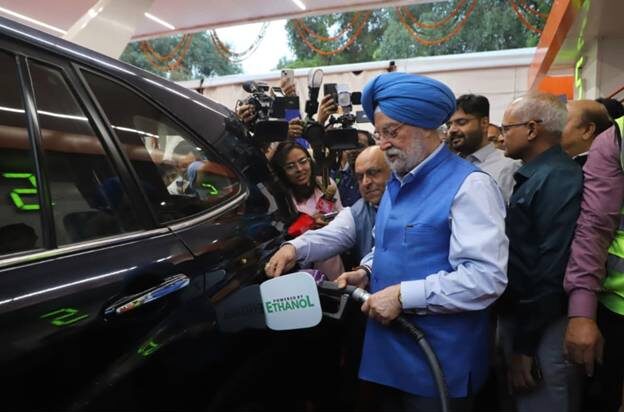
India marked a major step in its clean energy transition with the launch of E85 fuel at 48 retail outlets of public sector Oil Marketing Companies (OMCs) on World Environment Day 2026. Union Petroleum and Natural Gas Minister Hardeep Singh Puri inaugurated the initiative at an IndianOil outlet in New Delhi, describing it as a significant milestone in strengthening India’s energy security, supporting farmers, and reducing dependence on imported crude oil.
E85 is a high-ethanol blended fuel containing 80–85% ethanol and 14–19% petrol, designed specifically for flex-fuel vehicles (FFVs). These vehicles can operate on ethanol blends ranging from E20 to E100, providing consumers with greater fuel flexibility. The government plans to expand E85 availability from the current 48 outlets to 500 outlets by December 2026 and around 5,000 outlets by December 2027.
Priced nearly ₹20 per litre lower than conventional petrol, E85 is expected to offer significant savings to consumers while promoting the use of domestically produced ethanol. According to the government, ethanol blending in India has increased from 1.53% in 2014 to 20% in 2026, achieving the target five years ahead of schedule. This progress has helped save more than ₹1.84 lakh crore in foreign exchange and reduced crude oil imports by nearly 302 lakh metric tonnes.
The government highlighted several environmental benefits of E85, including a reduction of around 61% in lifecycle greenhouse gas emissions compared to conventional petrol. The fuel’s high octane rating also improves engine efficiency and promotes cleaner combustion, leading to lower particulate emissions and better urban air quality.
The minister emphasized that ethanol-powered vehicles run on fuel produced by Indian farmers, transforming them from “Annadatas” (food providers) to “Urjadatas” (energy providers). He noted that wider adoption of flex-fuel vehicles could generate substantial income for farmers, save foreign exchange, and further strengthen India’s journey toward energy self-reliance and sustainable mobility.
