

(HT)
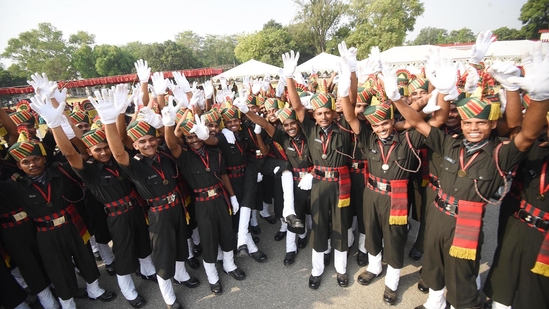
At least 3,000 Agniveers — barely 20 years old and recruited during the last two years — manned critical weapons and systems integral to the army’s hardy air defence (AD) shield activated during Operation Sindoor, which Pakistan couldn’t punch through despite launching wave after wave of missile and drone attacks on multiple Indian military installations, airbases and cities during the May 7-10 clash between the two nuclear-armed neighbours, people aware of the matter said on Wednesday.
The young and gritty soldiers, recruited under the Agnipath model, made their training count at a pivotal moment and acquitted themselves honourably in different roles during the four-day military confrontation that sparked fears of a full-blown shooting war with Pakistan, said one of the persons cited above, asking not to be named.
“The Agniveers faced a baptism by fire and helped ward off the enemy’s attempts to target our bases and cities. Feedback from the army’s frontline AD units shows they have earned their spurs, and their performance was on par with regular soldiers. This should settle the debate around the Agnipath scheme,” he added.
Several of the AD units that fended off the Pakistani missile and drone attacks had 150-200 Agniveers each in their ranks, HT learns.
Operation Sindoor, which began in the early hours of May 7, was New Delhi’s muscular response to the Pahalgam terror attack that killed 26 people. It triggered four days of strikes and counterstrikes with fighter jets, missiles, drones, long-range weapons and heavy artillery before the two sides reached an understanding on stopping all military action on May 10.
The Agnipath scheme for recruiting personnel below officer rank (PBOR) in the three services, for long a political hot button, was introduced around three years ago with the stated objective of keeping the armed forces young and battle-ready. Agnipath was a major departure from the military’s decades-old recruitment system that was scrapped when the National Democratic Alliance (NDA) government announced the new scheme in June 2022. It recruits soldiers for only four years, with a provision to retain 25% of them in regular service for another 15 years.
The Agniveers helped operationalise the locally developed air defence control and reporting system, called Akashteer, which emerged as the centrepiece of India’s AD grid during the clash, said a second person, who also asked not to be named.
The Agniveers posted in AD units deployed along the western front specialised in four main trades: gunners, operator fire control, operator radio and drivers of heavy-duty vehicles mounted with guns and missiles, the people said.
They excelled in each of these roles.
The Agniveers, alongside the regular soldiers, took down targets with shoulder-fired missiles; manned and fired guns including the upgraded L-70s and Zu-23-2Bs; operated the Pechora, Schilka, OSA-AK, Strela and Tunguska weapons, and the medium-range surface-to-air missile system; manned a variety of radars and Akashteer nodes; were an integral part of the communication network; and drove vehicles used for transporting and launching missiles, including Akash, the people said.
The drivers also doubled as sentries after the weapon systems were deployed in the combat zone.
Only young men and women aged between 17 and a half and 21 are eligible under the Agnipath scheme. Agniveers draw an annual salary of Rs 4.76 lakh in the first year of service and Rs 6.92 lakh in the fourth, get a non-contributory insurance cover of Rs 48 lakh, and an additional ex-gratia payment of Rs 44 lakh for death attributable to service.
Those released after four years will get Rs 11.71 lakh as Seva Nidhi severance package, including Rs 5.02 lakh contributed by them during their service.
Soldiers recruited under the legacy system serve for about 20 years before they retire in their late 30s with pension and other benefits including health care and canteen facilities, which Agniveers released from service after four years are not entitled to.
The government has reserved 10% vacancies in the Central Armed Police Forces, and several defence public sector undertakings are making similar amendments to their recruitment rules along with age relaxation to hire Agniveers. Some states, including Haryana and Rajasthan, have already announced reservations for Agniveers in their police forces.
Last September, the Indo-Russian joint venture BrahMos Aerospace Pvt Ltd, which manufactures the BrahMos supersonic cruise missile, became the first major company to officially announce reservations for Agniveers across various functions. It said at least 15% of technical and general administration vacancies will be reserved for Agniveers for whom at least 50% positions have also been earmarked in security and other administrative functions at various centres where such tasks were earlier outsourced.
The scheme, which the Opposition Congress repeatedly called for scrapping, came under fire from aspirants across the country, especially the northern states, and is believed to have cost the Bharatiya Janata Party (BJP) a chunk of votes across the region in the 2024 national elections. It was opposed as it cuts tenure of PBOR and offers them fewer service benefits.
The confrontation also marked a baptism by fire for the Akashteer system inducted only a year ago; it punctured multiple waves of Pakistani aerial attacks by guaranteeing prompt detection and targeting of the incoming threats. The army bought the automated system from Bharat Electronics Limited for Rs 1,982 crore.
The agile system, an integral part of the Indian military’s multi-layered AD grid, played a pivotal role in detecting, identifying, tracking and engaging Pakistani missiles and drones. The system essentially integrates a raft of AD sensors and weapons, expedites decision-making and tightens the sensor-to-shooter loop for swift detection and destruction of hostile targets.
It is integrated with the Indian Air Force’s Integrated Air Command and Control System (IACCS), the beating heart of the military’s four-tiered AD shield that Pakistan couldn’t penetrate.
“Akashteer is a combination of hardware and software systems in mobile command posts with fully integrated high-tech communication systems. It sharpened the army’s posture and allowed it to control the AD battle by providing ground units (which had Agniveers, among others) with the complete battle picture to respond in a swift and integrated way to neutralise the threats,” a senior official earlier said.
Pakistan launched missiles and drones in its attempt to target several locations in India’s north and west including Awantipora, Srinagar, Jammu, Pathankot, Amritsar, Kapurthala, Jalandhar, Ludhiana, Adampur, Bathinda, Chandigarh, Nal, Phalodi, Uttarlai, and Bhuj.
The locally produced military hardware that packed a formidable punch during the military confrontation with Pakistan included Akash surface-to-air missiles, the Samar (surface-to-air missile for assured retaliation) system and several counter-drone weapons.
The threats countered by the Indian forces included Chinese-origin PL-15 air-to-air missiles, long-range rockets, loitering munitions, and Turkish-origin drones.
India’s AD grid operated with multiple weapons across four levels, depending on the distance of the incoming target. The weapons that formed part of the grid included the S-400 system.
The Pakistan Army attempted to target Golden Temple in Amritsar with long-range missiles and drones on the night of May 7-8, but India’s AD shield fended off the attacks.
India launched Operation Sindoor in the early hours of May 7 when the army and IAF hit nine terror camps inside Pakistan and Pakistan-occupied Kashmir, killing more than 100 terrorists. And between the strikes on the terror sites and the calling of the ceasefire on May 10, the IAF struck multiple military targets in Pakistan.
The nine terror camps hit by the Indian forces with a mix of missiles and smart munitions included Markaz Subhanallah in Bahawalpur, Markaz Taiba near Muridke, Mehmoona Joya in Sialkot, Sawai Nala and Syed Na Bilal in Muzaffarabad, Gulpur and Abbas in Kotli, Barnala in Bhimber, and Sarjal. The IAF struck targets at 13 airbases and military installations in Rafiqui, Murid, Chaklala, Rahim Yar Khan, Sukkur, Chunian, Pasrur, Sialkot, Skardu, Sargodha, Jacobabad, Bholari and Malir Cantt in Karachi; the worst hit that Pakistan took after the 1971 war.
